Because of the physical and mental demands of military service, many veterans develop sleep conditions like insomnia, nightmare disorder, or the most common, sleep apnea. Due to these demands and other environmental factors during service, the risk of hypertension can increase.
Don’t fight the VA alone

Since sleep apnea and hypertension can be closely connected, many veterans experience both. This often leads to questions about whether or not you can file a sleep apnea claim secondary to hypertension, or vice versa.
In this article, we explain how hypertension and sleep apnea may be service connected and how veterans can file a sleep apnea secondary to hypertension VA claim.
Key Takeaways
- Many veterans are at risk of developing hypertension and sleep apnea, and they may be eligible to receive VA disability for these conditions.
- Research has found around half of people with sleep apnea also have hypertension.
- If you have service-connected sleep apnea, you may be able to claim hypertension as a secondary disability for additional compensation.
In this article about hypertension secondary to sleep apnea VA claim:
Veterans and hypertension
Hypertension (chronic high blood pressure) occurs when the force of the blood pushing against your artery walls is too high, making it harder for your heart to pump blood.
Factors among veterans that may increase their risk of hypertension include:
- Chronic stress and poor mental health
- Engaging in combat
- Exposure to Agent Orange
- Vitamin D deficiency
- Substance abuse
VA rating for hypertension
Veterans with service-connected hypertension may be eligible for a hypertension VA rating. The VA uses criteria under diagnostic code 7101 to evaluate a veteran’s condition and assign a rating.
Veterans and sleep apnea
Sleep apnea is a condition in which your breathing stops and starts while you sleep. It can increase the risks of developing other health conditions such as hypertension, heart complications, diabetes, liver problems, and more.
According to one study, sleep apnea may be as much as twice as prevalent among veterans than civilians, with deployment increasing the risk.
VA rating for sleep apnea
If you’re a veteran with sleep apnea, you may be eligible for a VA rating for sleep apnea. Sleep apnea is evaluated by the VA under diagnostic code 6847.
Hypertension secondary to sleep apnea VA claim
A significant amount of research has found a link between hypertension and sleep apnea.
According to a study in the Journal of the American Medical Association, people with moderate to severe obstructive sleep apnea have a higher chance of developing hypertension than those without. Research has found around half of people with sleep apnea also have hypertension.
If you have obstructive sleep apnea, your airway collapses repeatedly while you sleep. The subsequent drops in oxygen levels can lead to hypertension over time.
A veteran can receive a secondary service connection and VA disability rating for any health condition that is medically related to another condition that’s service connected.
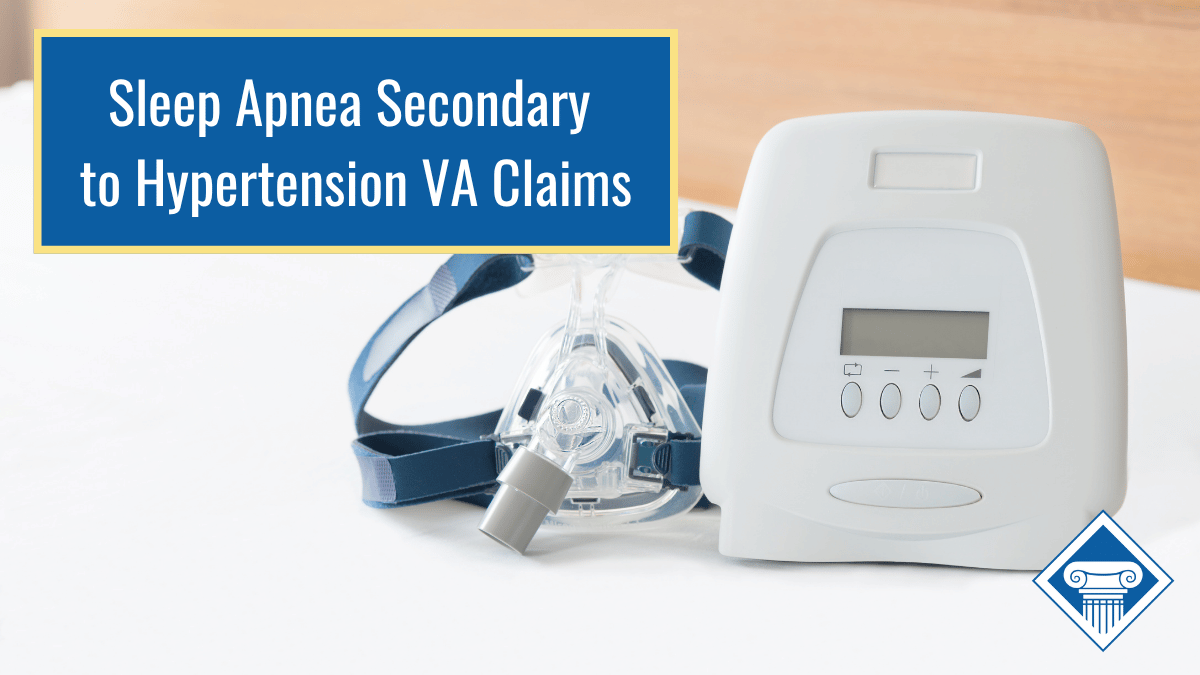
That means if you’re a veteran with sleep apnea tied to your service, and you also develop high blood pressure, you could be eligible for a VA rating for hypertension secondary to sleep apnea.
Excellent, friendly and professional. Got me 100% P&T. Very grateful for how they have helped my family and I.

B.M., an Army veteran in Kentucky
From a Google review for Woods & Woods
How Woods & Woods can help
At Woods & Woods, we focus on helping non-working veterans with service-connected conditions get individual unemployability benefits and, in some cases, increased ratings. We also help survivors of veterans receive their DIC benefits. If you think we can help you with your claim, call us today for a free case evaluation. You won’t pay us unless we take and win your case.
Ready to get started?

Frequently asked questions
The connection between sleep apnea and hypertension has been frequently studied and the relationship has been described as “interrelated.” However, there is minimal evidence suggesting hypertension causes sleep apnea. There is much stronger evidence of sleep apnea causing hypertension.
You may be able to get a VA rating for hypertension secondary to sleep apnea if you can show your sleep apnea is service connected, and that your hypertension stems from sleep apnea. Research suggests there may be a connection between hypertension and sleep apnea, especially in those with moderate to severe sleep apnea.

Neil Woods
Neil Woods is a VA disability attorney and the owner and president of Woods & Woods. He received his law degree from Western Michigan University.