If you receive VA disability benefits, you may have seen a four-digit code listed next to your condition in your rating letter. That number is called a diagnostic code and is used in the Schedule of Ratings, which is in the Code of Federal Regulations, to categorize disabilities for rating purposes. This article will describe what diagnostic codes mean, how they affect your rating, and how the VA uses them if your condition is not listed in the rating schedule.

Let’s get started today
In this article about VA disability codes and ratings:
- What are VA disability diagnostic codes?
- How to read VA disability diagnostic codes
- How diagnostic codes affect my VA disability rating
- Identifying diagnostic codes for unlisted conditions: analogous ratings
- VA disability diagnostic codes for residual conditions
- How can Woods & Woods help?
- Frequently asked questions
What are VA disability diagnostic codes?
The VA uses diagnostic codes as an organizational tool for disability ratings. The VA Schedule for Rating Disabilities (VASRD) is a section in the Code of Federal Regulations (CFR) that guides the VA when assigning ratings for service-connected disabilities. In the VASRD, conditions are grouped by body systems and individually listed by diagnostic code in numerical order.

How to read VA disability diagnostic codes
The four-digit codes range from the 5000s to the 9000s. The first two numbers indicate the body system. The last two digits have been assigned to the specific service-connected condition within that body system.
For example, the diagnostic codes for cardiovascular diseases start with “70.” Hypertension, which is listed in the ratings schedule as hypertensive vascular disease, is diagnostic code 7101.
The following table outlines diagnostic code numbers and their corresponding body systems.
| Diagnostic code number ranges | Body system |
|---|---|
| 5000s – 5200s | Musculoskeletal system |
| 5300s | Muscle injuries |
| 6000s | Eye |
| 6200s | Ear and other sense organs (nose and taste buds) |
| 6300s | Infectious diseases, immune disorders and nutritional deficiencies |
| 6500s – 6800s | Respiratory system |
| 7000s – 7100s | Cardiovascular system |
| 7200s – 7300s | Digestive system |
| 7500s | Genitourinary system – dysfunctions and diagnoses |
| 7600s | Gynecological conditions and disorders of the breast |
| 7700s | Hemic and lymphatic systems |
| 7800s | Skin |
| 7900s | Endocrine system |
| 8000s – 8900s | Neurological conditions and convulsive disorders |
| 9200s – 9500s | Mental disorders |
| 9900s | Dental and oral conditions |
How diagnostic codes affect my VA disability rating
While the exact diagnostic code number does not determine your disability rating or your monthly compensation, it does help you find your condition in the CFR so you can see the VA’s rating criteria and determine if the VA has rated you fairly.
“The Code of Federal Regulations sets out rating criteria by condition and those conditions are organized by diagnostic codes,” said VA disability lawyer Zack Evans. “The percentiles (ratings) under that code correspond to the symptoms that you may be experiencing.”
Essentially, under each diagnostic code in the Schedule of Ratings, you’ll find the name of the condition, a list of ratings, and set of criteria for each rating that is based on the severity of symptoms.
The rating percentages determine how much your monthly VA check will be.
Finding a diagnostic code in the Schedule of Ratings
Let’s look at the entry for our previous example, hypertension (code 7101), to see how this works. Use the table above to find the diagnostic codes that begin with “71.” If you point your cursor on the words “Cardiovascular system” and click, it will open a new window that takes you the ratings table for heart conditions in the CFR.
Scroll down that page to find 7101 Hypertensive vascular disease (hypertension and isolated systolic hypertension).
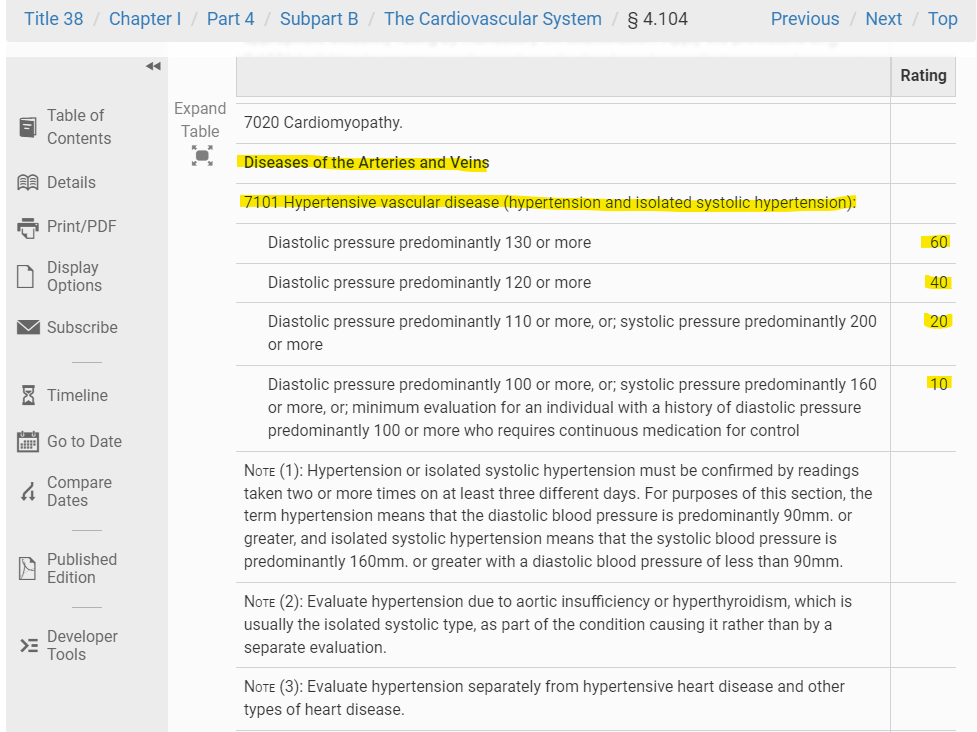
The left column under 7101 lists the symptoms, which are based on blood pressure readings, and the right column lists the VA rating for each set of symptoms for high blood pressure. A veteran with a consistent diastolic pressure of 130 of more is eligible for a 60% VA rating. If we look at the VA disability rates this year, we see that a 60% is worth $1,434.02 a month.
Lower diastolic blood pressures qualify for lower ratings of 40%, 20%, and 10%.
Using this example, it would not be difficult to determine if the VA made an error in assigning your rating or how much your rating would increase or decrease in the event your overall predominant blood pressure readings change.
However, other conditions, in the Schedule of Ratings such as traumatic brain injuries (code 8045) and the ratings for mental health disorders are not as easy to read or understand. Sometimes, it pays to contact a VA-accredited attorney like Woods & Woods for a free consultation.
Identifying diagnostic codes for unlisted conditions: analogous ratings
If you do not see your condition in the rating schedule, it does not mean you can’t get benefits. When conditions are not listed, the VA gives service-connected conditions an analogous rating, which means it rates them based on conditions that are most closely related. The VA considers the veteran’s symptoms, which body system is involved, and how the condition affects the veteran’s daily activities and functions.
If you receive an analogous rating, the last two digits of the diagnostic code will be “99.” Conditions without a designated diagnostic code are rated using the criteria of an analogous (or similar) condition with the same symptoms.
For example, esophageal ulcers do not have a diagnostic code, so the VA commonly uses the ratings for hiatal hernia (code 7346) because the symptoms of the conditions are similar.
Woods & Woods’ experience will give you the best chance to get what you deserve.

T.K.
From a Google review for Woods & Woods
VA disability diagnostic codes for residual conditions
When your service-connected condition has been treated but you experience lingering negative effects, the VA considers them residual conditions. These will be identified in your rating decision using an eight-digit diagnostic code. The first four numbers will be the diagnostic code for the original condition and the following four numbers correspond to the new condition caused by the treatment. The VA does this so the exact source of each rating can be easily identified.

How can Woods & Woods help?
If you find your disability in the Schedule of Ratings and think that your symptoms are more severe than your current rating reflects, you might want to appeal the decision. Woods & Woods can help you through that process. If you have any questions about your case, call us. You will never have to pay us unless we win your appeal.
Let’s appeal your VA decision today

Frequently asked questions
The VA uses diagnostic codes as a guide to assigning disability ratings. The VA Schedule for Rating Disabilities (VASRD) is a section in the Code of Federal Regulations (CFR) that organizes these diagnostic codes. Conditions are grouped in the VASRD by body systems and individually listed by diagnostic code in numerical order.
Yes. If you do not see your condition in the rating schedule, it does not mean you can’t get benefits. When service-connected conditions are not listed, the VA can assign an analogous rating, which means it rates them based on the condition that is most closely related to the unlisted condition.

Neil Woods
Neil Woods is a VA disability attorney and the owner and president of Woods & Woods. He received his law degree from Western Michigan University.