“My name is Joe Scott. I’m an attorney with Woods & Woods, a veterans disability law firm.
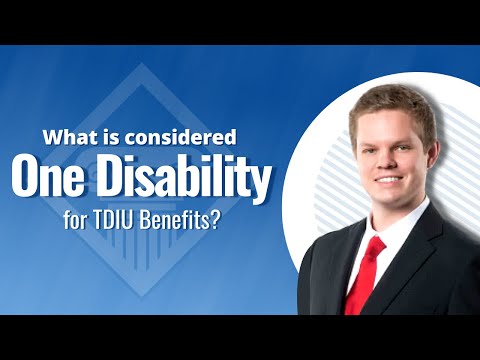
“Today, I’m going to be talking about what VA can consider to be a single disability for the purposes of veterans who say their benefits render them unemployable.”
What is TDIU?
“TDIU stands for total disability based on individual unemployability. What that means is if a person’s service-connected disabilities preclude them from earning what the VA calls substantially gainful employment, they’re considered totally disabled by VA standards. It’s a pretty intricate concept.
“TDIU has two types of eligibility. I’ll be talking about the first one, which is when you meet the schedular or percentage requirements, which is called schedular TDIU. There is another type, for reference, called extraschedular TDIU, where if your overall rating percentage doesn’t meet the typical threshold, you can still apply for it. But again, I’ll be speaking about how you can be considered eligible for schedular TDIU.”
Who qualifies for TDIU?
“Typically, you have to have what VA calls a single disability ratable of at least 60%. So, a single disability at 60%, or you can have a combination of disabilities that equate to 70% or more, but one of those conditions has to add up to at least 40% under that 70% umbrella.”


How does the VA calculate combined ratings?
“VA calculates combined ratings in a different manner than normal math. For example, you may have a 50% disability plus another 50% disability that doesn’t equal 100%. It’s an odd system that doesn’t frankly make sense on the surface, but that’s where these additional criteria become even more useful, because you may not have that 100%, but you can have alternate means to being ‘totally disabled.’”
What is considered one disability?
“The idea of one disability is frankly broader than what I thought it would be. There are certain provisions within the regulation that govern unemployability, and if you want to follow along, they can be found in 38 CFR 4.16 (a). So, it’s good to read along and see what I’m talking about.
“It sounds counterintuitive, but a single disability can actually be multiple disabilities that fit under that umbrella of a single issue.
“So, there are five provisions within it. I’ll just go one by one.”
1. Disabilities that involve one or both upper/lower extremities
“The first one would be disabilities involving one or both upper extremities or one or both lower extremities. That one’s pretty straightforward.
“It pretty much is as it sounds, but there’s one little caveat. It includes what’s called the bilateral factor. So, if both upper or both lower extremities are service connected, VA typically rates those a little bit higher than what their normal math evens out to. The theory is they think that if you have paired extremities that are injured, that’s more disabling than if it were just one, or two extremities on opposite sides of the body.
“If you have some combination of that, theoretically you can have four or potentially more conditions that are all rated as a single disability because they all involve the various extremities.”
2. Issues that share a common etiology
“The second one is conditions that share a common etiology, or a single accident. I think of those as a two-sided coin.
“Etiology means the medical origin of a condition. So, if a healthcare professional finds that multiple conditions that are seemingly otherwise not connected fall from the same medical route, that’s a single disability for VA purposes.
“Conversely, the fact-finding side of that coin is a single accident. So, that’s what it sounds like. If you have a single in-service event that causes multiple types of injuries, VA should consider those to all be under that umbrella of a single disability.”
Just when I was about to give up because of claim denials over the years, I put my trust into Woods & Woods to represent me to receive the 100% I fought so hard for after no results. Thanks Woods & Woods for encouraging me to stay and finish the battle. You rock!

R.W., a veteran in Texas
From a Google review for Woods & Woods
3. Conditions that affect the same body system
“The next one is a single system of the body. That sounds like it makes sense, but it can get gray pretty quickly.
“If you read the regulation, the VA will cite examples and they won’t always give a lot of definition as to what those entail. So, for example, it may say “cardiovascular/renal.” So — kidney issues. But does that mean that if you have a kidney condition and a cardiovascular condition together? Sometimes it doesn’t always seem so clear cut, and that can kind of loop into common etiology. But it can also just be multiple conditions that a singular system is affected by.”
4. Multiple disabilities incurred in action
“Incurred in action, in essence, means that if two disabilities are combat-related, regardless of whether they are connected otherwise, if those both happened during combat, VA should consider those to be a single disability.”
5. Conditions incurred as a result of being a prisoner of war (POW)
“The last one is conditions incurred as a result of being a prisoner of war. So, it’s analogous to incurred in action. If you’re a POW and you have multiple disabilities that arise from that status, VA considers those a single disability.”
How an accredited VA disability lawyer can help
“If these provisions seem complex and intricate, that honestly is accurate. They are, and VA doesn’t always read them in the ways that we think they ought to.
“The CFR, the Code of Federal Regulations that governs what VA does, often seems straightforward and you can read it that way and that’s how you might think it ought to be, but the application can be very different. And again, each case is unique, so sometimes it can work out pretty cleanly, and sometimes it’s almost anything but. So, if it’s more complicated or you think you need assistance with it, we’re happy to help you.
“If veterans have more questions about this, if they think it applies to them, or if they’re just curious about what VA benefits are available to them, they’re free to reach out to us at Woods & Woods for a free consultation.”
Let’s appeal your VA decision today


Joseph Scott
Joseph Scott earned a law degree from Valparaiso. He was an attorney at the Vietnam Veterans Association before joining the Woods & Woods team in 2020.