Applying for VA disability can be a lot of work, and gathering medical records to support your claim takes additional time and energy. If records are lost or missing or you are having to make repeated requests for a single document, this can add another layer of stress and frustration to the process. But can you skip ahead and file a VA claim without medical records?
Get help from a VA-accredited attorney
In this article, we explain if you can get VA disability without medical records, what can be done about missing records, and other types of evidence you can use to support your claim.
Key Takeaways
- While you can submit your initial application without medical records, in order to get VA disability, the VA will eventually need medical evidence.
- The VA has a duty to assist in collecting your medical records, with permission.
- There is a process for reconstructing lost records, in rare instances where they have been permanently destroyed.
- If you have missing medical records, it can be useful to include other types of evidence with your claim, like lay statements and employment records.
In this article on whether you can file a VA claim without medical records:
What is VA disability?
VA disability is a tax-free monthly benefit paid to eligible veterans by the VA. It’s intended to assist veterans who leave service with a new or worsened health condition.
You may be eligible for VA disability if you:
- Served on active duty, active duty for training, or inactive duty for training
- Have a mental or physical health condition caused by your time in the service
- Have an other than dishonorable discharge
Veterans can apply by filling out form 21-526EZ and submitting evidence to support their claim.
By the end of 2024, 5.9 million U.S. veterans around the country and the world qualified for VA disability and were receiving payments, with hundreds of thousands of new veterans added every year.
Can you file a VA claim without medical records?
According to the VA, there are a few types of evidence the agency needs access to for any disability claim. These are:
- Your DD214 or separation documents
- Your service treatment records
- Medical evidence related to your illness or injury
However, the VA also states you can submit a claim without evidence. This is because you can request that the VA gather evidence for you, or submit evidence up to a year after you send in your VA disability application.
The team there at Woods and Woods did outstanding. VERY professional. They cut through the red tape and got me what I needed ASAP. They truly are The Veterans Law Firm.

E.L., an Army veteran in Nebraska
From a Facebook review for Woods & Woods
In other words, you can submit your initial application to the VA without medical records, but in order to get VA disability, the VA will eventually need medical evidence and may reach out to you for it if you do not provide it.
Medical records help the VA determine the duration and severity of your health condition, and they can be used to verify your diagnosis, treatment, and more. They can also help clearly highlight your symptoms and any fluctuations in your illness over time.
Additionally, medical records from before, during, and after your time in service can all help support service connection. They can show the progression of your condition over time.
In-service records can be especially helpful for establishing service connection. For example, if you went to the sick bay reporting knee pain after a training injury and you still experience complications from that injury today, those records have the potential to strengthen your claim.
Lost medical records
There are several reasons a veteran might be hesitant to include medical records in their VA claim.
First, the information can feel very private and vulnerable. But the VA will have to learn about your condition and how it affects your day to day life in order for you to receive the disability benefits you deserve.
Next, gathering documents can be a hassle. However, as previously mentioned, the VA has a duty to assist in collecting this information. This includes both government records from the DOD and VA health clinics, as well as private medical records, with your permission.
You can also gather medical documents on your own. One way to access documents is by making a request to the National Archives. They can help you find a variety of records from your time in the military, even if you have lost your copy.
In rare cases, the government has permanently lost medical records. An example of this is the 1973 fire at the National Personnel Records Center (NPRC) in St. Louis. The fire destroyed thousands of records belonging to some Army and Air Force personnel from the 1910s through the 1960s. The VA now has a process for reconstructing these lost records.
Additional evidence to support your VA claim
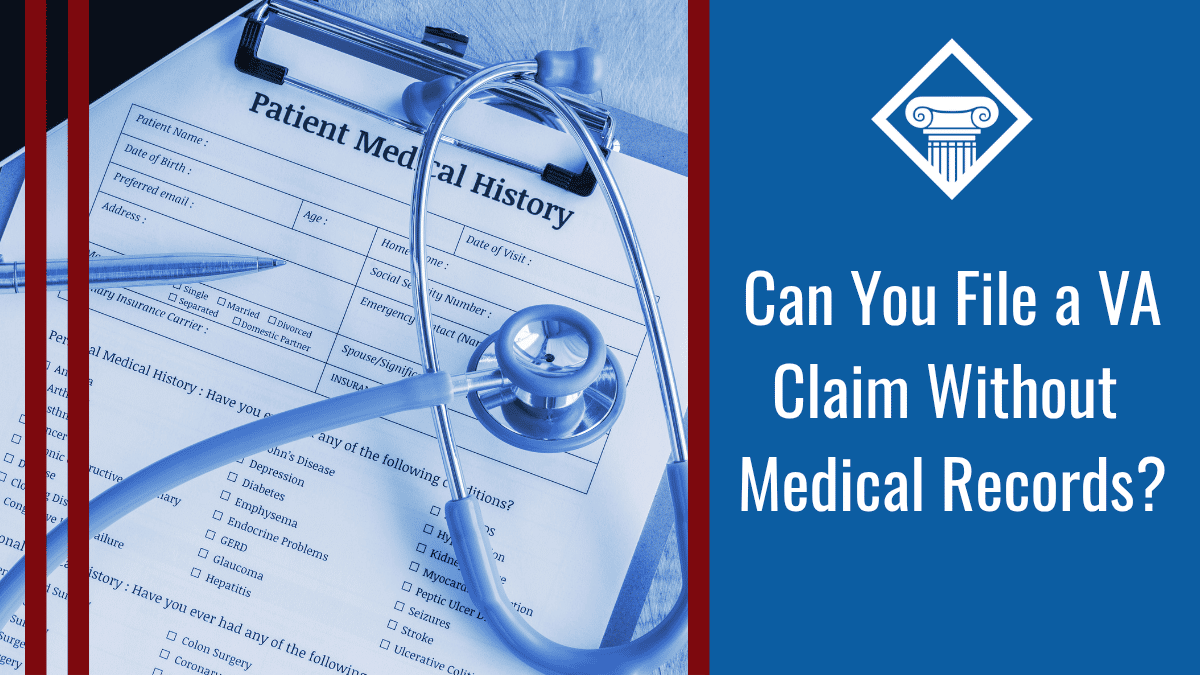
If you have lost, missing, or incomplete medical records, it may be especially useful to include other types of evidence to support your VA disability claim.
Other evidence can include, but is not limited to:
- Service records. The VA will want to know the details of your service. When did you serve? Where? What is your discharge status? Records like your DD214 can help answer these important questions.
- Lay statements. A lay statement is a personal testimony from someone who knows you. Information shared by the “lay” person (someone who is not a trained medical professional) is meant to describe your life before, during, or after military service, in relation to your medical condition. Lay statements can be written by friends, family, current or ex-spouses, coworkers or employers, buddies from service, and so on.
- Personal journal entries. Logging the way your symptoms affect your daily activities, mental health, and relationships can help illustrate your disability’s impact in your own words. These journal entries can help guide the conversation during your C&P exam, or be submitted with evidence for a disability claim.
- Employment records. These can help prove you have had trouble maintaining work due to your illness. Your records may indicate patterns of calling in or having symptomatic episodes on the job, or being accommodated or even let go.
- Photographs. Sometimes a veteran will have photographs that help prove they were in a specific location, working on a specific ship or aircraft, etc. These photos may fill in gaps in your service records. If you have a photo that supports your disability claim, it can be submitted as evidence.
How Woods & Woods can help
Woods & Woods has been fighting for people with injuries and disabilities since 1985. Our team of accredited VA disability lawyers, case managers, legal analysts, and intake specialists know the ins and outs of the VA so you don’t have to do all the hard work. Call us today for your free and confidential case evaluation.
Don’t fight the VA alone
Frequently asked questions
You can submit your initial application to the VA without medical records, but in order to get VA disability, the VA will eventually need to share medical evidence.
You will need to allow the VA access to some medical records to get VA disability. The VA does not specify any types or amounts of records it needs, but the more evidence you provide, the more clearly your disability can be understood.

Neil Woods
Neil Woods is a VA disability attorney and the owner and president of Woods & Woods. He received his law degree from Western Michigan University.