If you developed hip problems due to your military service and now need a replacement, you may be owed VA disability compensation. Hip replacement surgery is often connected to other service-connected conditions. You may qualify for a VA rating for hip replacement.

Let’s get started today
You don’t realize how much you use your hips until they start to give out. But what started as an occasional ache has now become significant, ongoing pain. Now, the doctor says you need a hip replacement. The condition that caused this need may be related to your military service. It’s time to learn about VA disability for hip replacement and what you can expect.
Key Takeaways
- Veterans can get VA disability for a hip replacement, if the reason they need the surgery connects back to their military service.
- Service-connected arthritis, AVN, and injuries can all lead to needing a hip replacement.
- Veterans whose joint pain and issues prevent them from working may be eligible for VA TDIU benefits.
In this article about the VA rating for hip replacement:
Hip replacement in veterans
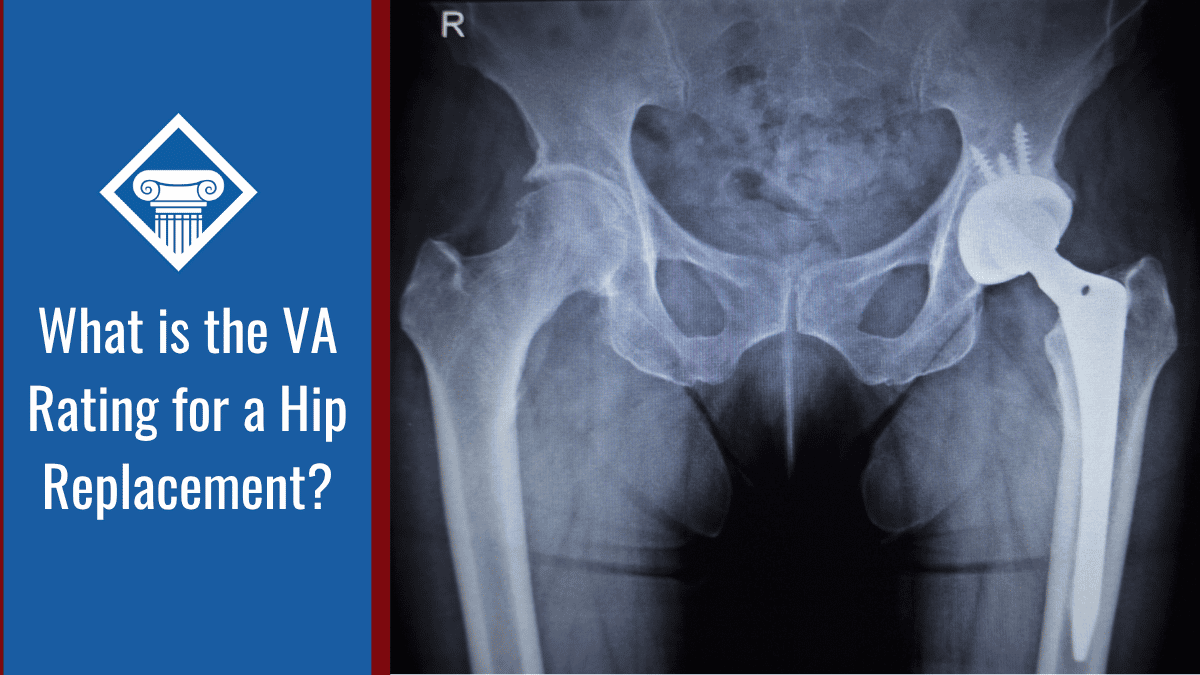
A hip replacement is a surgical procedure where doctors remove damaged sections of your hip joint and replace it with artificial joints that are metal, ceramic, or hard plastic. It’s also sometimes called a “hip arthroplasty.”
There are two main types of hip replacements:
- Total hip replacement: Both the ball and the socket of the hip are replaced.
- Partial hip replacement: Only the ball of the hip is replaced.
Doctors typically recommend hip replacements when the joint has deteriorated so much that it limits mobility and causes a lot of pain. They usually try physical therapy and medications first, and you can receive VA disability benefits for hip pain regardless of whether a hip replacement is necessary.
Veterans may be prone to hip conditions that result in the need for a hip replacement because of the physical demands of service. Veterans’ bodies are often put under a lot of movement-related stress during active duty, causing wear and tear on the body that may cause conditions leading to hip-related issues.
Conditions that can lead to a hip replacement
Various factors can cause hip damage and lead to the need for a replacement. Research shows that four conditions most commonly result in the need for a hip replacement:
- Osteoarthritis: Cartilage breakdown from age and long-term wear can cause osteoarthritis and is the most common cause of hip replacements.
- Avascular necrosis (AVN): AVN occurs when the blood supply to the ball of the hip joint is disrupted, causing bone tissue to die. As the bone weakens and eventually collapses, it leads to secondary osteoarthritis in the joint. Risk factors for AVN include alcohol use, long-term steroid use, smoking, and clotting disorders.
- Physical trauma: Fractures can damage the hip immediately or set the stage for degeneration years later. Even if the injury is treated promptly, these issues frequently lead to secondary osteoarthritis.
- Inflammatory arthritis: Conditions like rheumatoid arthritis and ankylosing spondylitis cause chronic inflammation that may gradually destroy tissue in the hip joint.
VA rating for hip replacement
The VA rates hip replacement using diagnostic code 5250 in the Schedule of Ratings. Veterans are awarded 100% VA disability or $3,938.58 for four months after the hip replacement surgery. In some cases, this can be extended if you experience severe complications.
After a temporary total rating period ends, hip replacements are rated as follows:
TDIU for hip issues
In some cases, a veteran may be awarded total disability based on individual unemployability (TDIU) for a hip replacement and related hip issues. TDIU is also known as individual unemployability or simply IU. Veterans are eligible for these benefits if they can’t hold down “substantially gainful” employment due to their service-connected conditions.
Veterans with hip issues may struggle to stand for long periods, bend down, or move around comfortably at work. If their knee pain is caused by a condition like arthritis, sitting, lifting, and other tasks may also be difficult or even impossible This can severely limit a person’s ability to work enough to support themselves.
Veterans who receive TDIU benefits are compensated at the same level as those with a 100% disability rating, even though their combined rating is below 100%.
Veterans will typically be eligible for TDIU if they have:
- At least one service-connected disability rated at 60% or more disabling OR
- Two or more service-connected disabilities with at least one rated at 40% or more disabling and a combined rating of 70% or more
By far the best law firm for veterans. No one would take my case and the VFW said I would never get anything from the Army. Woods & Woods said something very different and his law firm proved it. Not only did they get me full benefits, but they also got me 19 years of back money. If you go with a different lawyer, you’re just plain wrong and you will not get what you deserve. God bless Woods & Woods…

A.B., an Army veteran in Pennsylvania
From a Google review for Woods & Woods
How Woods & Woods can help
Woods & Woods has been fighting for people with injuries and disabilities since 1985. Our team of accredited VA disability lawyers, case managers, legal analysts, and intake specialists know the ins and outs of the VA so you don’t have to do all the hard work. Call us today for your free and confidential case evaluation.
Don’t fight the VA alone

Frequently asked questions
The VA rating for a hip replacement is 100% for four months following the surgery. After that, it’s rated based on how much pain, weakness, or mobility concerns remain. This rating can be 90%, 70%, 50%, or 30%.
Yes, you can receive VA disability benefits for hip pain. You can also receive TDIU for hip-related pain or after a hip replacement, depending on how limiting the condition is.

Neil Woods
Neil Woods is a VA disability attorney and the owner and president of Woods & Woods. He received his law degree from Western Michigan University.