Tinnitus and migraines are two health complications veterans commonly experience. Both can be unpleasant individually, and combined, they may begin to affect a veteran’s day to day life. For some, developing these conditions means a total loss of silence and frequent, debilitating pain that can also take a toll on mental health.

Let’s get started today
If you believe your migraines are related to your service-connected tinnitus, you could be owed VA disability compensation for both conditions. In this article, we explain migraines and tinnitus in veterans, how the two may be linked, and how to get a VA rating for migraine headaches secondary to tinnitus.
Key Takeaways
- More than a million veterans currently receive VA disability compensation for migraines, making it the ninth most commonly service-connected condition.
- Some veterans have successfully claimed their migraines were caused by service-connected tinnitus for VA disability benefits.
- If service-connected tinnitus and migraines make it difficult or impossible for you to work, you could be eligible for TDIU benefits.
In this article about migraine headaches secondary to tinnitus:
Migraines in veterans
Migraines are more severe and debilitating than an average headache, and may cause sensitivity to stimuli, nausea, weakness, and fatigue. Sometimes, migraines are accompanied by auras, which are sensory disturbances like blind spots or numbness that can warn an individual a migraine is coming on.
Migraines are diagnosed more commonly in veterans than civilians, especially among who deployed to Iraq. More than a million veterans currently receive VA disability compensation for migraines, making it the ninth most commonly service-connected condition.
The VA will assign a rating of 0%, 10%, 30%, or 50% under diagnostic code 8100, depending on the frequency and severity of symptoms.
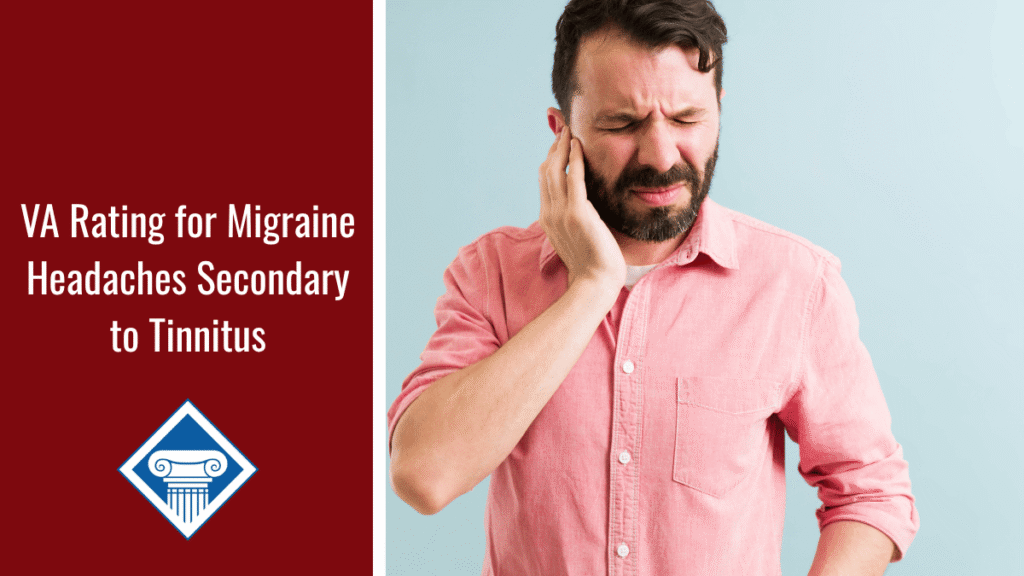
Tinnitus in veterans
Tinnitus causes a ringing, buzzing, or humming in the ears, almost always from a phantom source no one else can hear.
There are multiple possible causes of tinnitus, including certain medications and hearing loss. For veterans, tinnitus risk factors may also include blasts, heavy artillery fire, and head injuries.
Tinnitus is especially prevalent in veterans. In fact, it is currently the most commonly service-connected condition for VA disability compensation. 3.5 million veterans received VA benefits for tinnitus in 2025.
The VA rates tinnitus using diagnostic code 6260. Under this code, veterans may only receive a 10% VA rating for the condition if it happens repeatedly, regardless of whether it affects one ear or both.
VA rating for migraine headaches secondary to tinnitus
Research suggests there may be a connection between tinnitus and migraine headaches. The relationship between the two has been studied at length to understand the overlapping causes and triggers. The way they affect each other and why is still not fully understood, but it has been suggested both conditions may be able to cause or worsen the other.
Some veterans have successfully claimed their migraines were caused by service-connected tinnitus for VA disability benefits. While the VA does not formally recognize a connection between the two conditions, it is still possible to get a VA rating for migraine headaches secondary to tinnitus.
To do so, veterans will need to speak with a doctor about their health and ask if they will write a nexus letter. A medical nexus is the connection between a medical condition and its cause. If a doctor believes your tinnitus is causing your migraines, they may express this opinion in a letter you can submit to the VA.
My husband and I have worked with Woods & Woods for years. They were excellent. They walked us through the many stages of filing for disability. I recommend this firm to anyone that is struggling with VA disability [claims].

M.T, a veteran’s wife in Florida
From a Google review for Woods & Woods
TDIU for tinnitus and migraines
In some cases, a veteran may be awarded total disability based on individual unemployability (TDIU) for migraine headaches secondary to tinnitus. TDIU is also known as individual unemployability or simply IU. Veterans are eligible for these benefits if they can’t hold down “substantially gainful” employment due to their service-connected conditions.
Veterans with tinnitus and migraines may struggle to work if they have frequent headaches that cause them to take breaks or call off regularly. If their mental health is affected by these conditions, they may also struggle to work well with others, control their mood with coworkers and customers, or stay motivated and on track with tasks.
Veterans who receive TDIU benefits are compensated at the same level as those with a 100% disability rating, even though their combined rating is below 100%.
Veterans will typically be eligible for TDIU if they have:
- At least one service-connected disability rated at 60% or more disabling OR
- Two or more service-connected disabilities with at least one rated at 40% or more disabling and a combined rating of 70% or more
How Woods & Woods can help
At Woods & Woods, we focus on helping non-working veterans with service-connected conditions get individual unemployability benefits and, in some cases, increased ratings. We also help survivors of veterans receive their DIC benefits. If you think we can help you with your claim, call us today for a free case evaluation. You won’t pay us unless we take and win your case.

Our team is ready to help
Frequently asked questions
If you believe your service-connected tinnitus is related to your migraines, you could be owed VA disability benefits for both conditions. You will need to be prepared to prove the two conditions are medically linked. If the VA agrees your tinnitus and migraines are connected, you will receive a VA rating for tinnitus under diagnostic code 6260 and a migraine VA rating under code 8100.
If service-connected tinnitus and migraines make it difficult or impossible for you to work, you could be eligible for TDIU benefits. TDIU pays at the same rate as a 100% VA disability rating and is intended for veterans whose service-related health issues prevent them from working.

Neil Woods
Neil Woods is a VA disability attorney and the owner and president of Woods & Woods. He received his law degree from Western Michigan University.