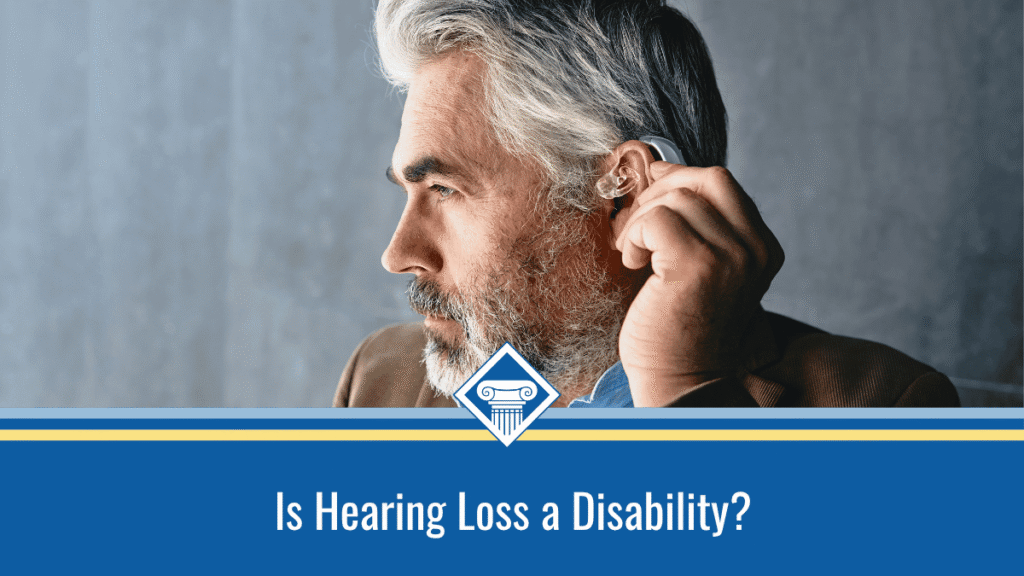
Hearing loss can be more than just a medical issue. It can deeply affect your daily life, relationships, and your ability to work.
For some, it’s a manageable inconvenience, but for others, it’s a disabling condition that leads to isolation and financial stress. If you’re struggling to keep a job or maintain your independence due to difficulty hearing, you might be wondering if hearing loss is a disability.
In this article, we’ll discuss how hearing loss is defined by the Social Security Administration, when hearing loss is considered a disability, and what steps to take if you’re considering applying for disability benefits for the condition.
Claim what you worked for.

Table of contents
- What is hearing loss?
- How is hearing loss measured?
- Is hearing loss a disability?
- How to get disability for hearing loss
- What other evidence can help your claim?
- How long does it take to get a disability decision?
- How do I appeal a decision if I was denied?
- How Woods & Woods can help
- Frequently asked questions
Key Takeaways
- Hearing loss may qualify as a Social Security disability if it meets the SSA’s strict medical criteria and prevents you from working for at least 12 months.
- The SSA relies on specialized hearing tests, including pure-tone and word recognition testing, to determine whether your hearing loss meets the requirements for disability benefits.
- Strong medical evidence is essential when applying for SSDI for hearing loss, including audiology test results, physician evaluations, and documentation of how your condition affects your ability to work and communicate.
What is hearing loss?
Hearing loss can vary greatly from person to person, ranging from mild to profound and affecting one or both ears. While many people experience some degree of hearing loss as they age, the definitions used by the Social Security Administration (SSA) are more specific.
While any hearing loss over 25 dB is considered an impairment, profound hearing loss or deafness is typically defined as a hearing threshold of 80 decibels (dB) or more in adults.
The table below shows a common way to classify hearing loss:
| Impairment level | Hearing loss range | Performance |
| No impairment | 25 dB or better | No hearing problems. Able to hear whispers. |
| Slight impairment | 26 to 40 dB | Able to hear and repeat words spoken in a normal voice |
| Moderate impairment | 41 to 60 dB | Able to hear and repeat words using a raised voice |
| Severe impairment | 61 to 80 dB | Hearing aids are likely needed. |
| Profound impairment or deafness | 80 to 94.9 dB | Hearing aids may help, but additional intervention will be needed. |
| Complete or total hearing loss | 95 dB or greater | Cannot hear any speech or sound |
How is hearing loss measured?
Hearing tests, or audiometry tests, are used to evaluate how well you hear and can identify the type and severity of hearing loss, whether it’s mild, moderate, or severe.
Common types of hearing tests include:
- Pure-tone testing: A common hearing test that measures the softest sounds you can hear at different pitches
- Bone conduction testing: This test checks for inner ear issues by assessing how sound vibrations move through the cochlea, the part of the inner ear that sends vibrations to your auditory nerve and brain
- Speech audiometry testing: A speech test that measures your ability to hear and understand spoken words at a comfortable listening level
- Auditory brainstem response (ABR): This test evaluates the hearing nerve and brain pathways between your inner ear and your brain. Audiologists may use this test to check hearing in those who can’t complete pure-tone tests and for people who have a brain injury that affects their hearing
- Tympanometry: This test checks how well your eardrums move, and an audiologist may do this test to see if you have a ruptured eardrum, fluid in the middle ear, or earwax buildup
Is hearing loss a disability?
According to the SSA, hearing loss is considered a disability under Section 2.10 and 2.11 of its Blue Book, which covers special senses and speech impairments.
You may qualify for Social Security Disability Insurance (SSDI) if your hearing loss prevents you from working. However, age-related hearing loss alone doesn’t meet the SSA’s criteria, nor does temporary hearing loss. According to the SSA, you must have had your condition for at least one full year to be eligible for SSDI.
You are automatically eligible for disability for hearing loss if you are completely deaf in both ears or after receiving a cochlear implant. However, for those with partial hearing loss, especially in just one ear, qualifying may be more challenging. We explain the specific eligibility criteria below.
How to get disability for hearing loss
The SSDI criteria for hearing loss vary depending on whether or not you have cochlear implants and the severity of your condition.
With cochlear implants: You are automatically considered disabled for one year following the implantation. After that, you must undergo a word recognition test. To continue receiving benefits, your score must be 60% or less on a standardized HINT test.
Without cochlear implants: You must meet at least one of the following criteria outlined in Section 2.10 of the SSA Blue Book:
- An average air conduction hearing threshold of 90 dB or greater in your better ear and an average bone conduction threshold of 60 dB or more.
- A word recognition score of 40% or less in your better ear using standardized speech tests.
Before testing, an otoscopic exam must be conducted to rule out any temporary conditions, like an ear infection, that could invalidate the results.
You’ll also need to provide medical evidence to support your disability claim, such as:
- Proof of a medically determinable impairment that causes your hearing loss
- Detailed measurements of the severity of your hearing loss
- A comprehensive ontologic examination by a licensed physician or an audiologist
- Additional information relevant to your condition, including any observations from outside a clinical setting
What other evidence can help your claim?
To build a strong case to support your disability application, you can start by reviewing the SSA’s specific criteria and directly linking your symptoms to the requirements listed in the Blue Book. Then you’ll want to gather extensive evidence showing your symptoms meet the SSA’s criteria.
Medical evidence can include:
- Medical history reports
- Clinical findings (such as the results of physical or mental status exams)
- Lab results or test results
- Imaging (such as CT scans, x-rays, and MRIs)
- Emergency room visit summaries
- Diagnosis
- Treatment prescribed based on response and prognosis
- A statement from a medical professional on what work activities they believe you are capable of doing despite your condition
- Any treatment information
- Info about your daily activities and capabilities
Submitting thorough medical evidence to support your diagnosis and keeping a personal log detailing how your symptoms impact your daily life and ability to work can also help support your claim. These details add valuable context and make your claim more compelling.
How long does it take to get a disability decision?
When considering how long a disability claim can take, it’s important to keep in mind that there is no one-size-fits-all answer.
The time it takes to get a disability decision depends on several factors, like whether the SSA needs more information to process your claim. On average, the wait for an initial SSDI decision is about 6.1 months, or roughly 188 days.
According to the SSA’s 2024 Annual Report, about 18% of applications were approved at this stage, meaning nearly four out of five claims were denied.
Don’t get discouraged if you’re denied. You can appeal, but be aware that the appeals process can add another six months or more to your wait.
How do I appeal a decision if I was denied?
If your SSDI application is denied, you have the right to appeal the decision. According to the SSA, approximately 80% of SSDI claims are rejected at the initial level, often due to insufficient medical evidence, limited work history, or other technical issues. Because the appeals process can take time, it’s important to act quickly – you only have 60 days to file your appeal.
While appealing a denial is always worthwhile, it doesn’t guarantee approval, as many applicants are denied even after multiple appeals. However, working with an experienced disability lawyer can help strengthen your case and improve your chances of success.
How Woods & Woods can help
Having a disability shouldn’t mean losing your peace of mind. At Woods & Woods, we help individuals with disabilities connect with legal help. If you’re seeking SSDI benefits, call us today for a free case evaluation.
Get the benefits you earned.

Frequently asked questions
Yes, the SSA considers hearing loss a disability if it meets the criteria listed in Sections 2.10 or 2.11 of its Blue Book of qualifying impairments.
A word recognition score of 40% or less in your better ear, measured using a standardized list of phonetically balanced monosyllabic words, may meet the SSA’s criteria for hearing loss. However, it’s difficult to qualify for SSDI based on hearing loss in only one ear.

Lori Underwood
Lori Underwood received her law degree from Northern Kentucky University. She previously practiced Social Security disability and personal injury law and was a juvenile court attorney.
She has been an attorney at
Woods & Woods since 2014.