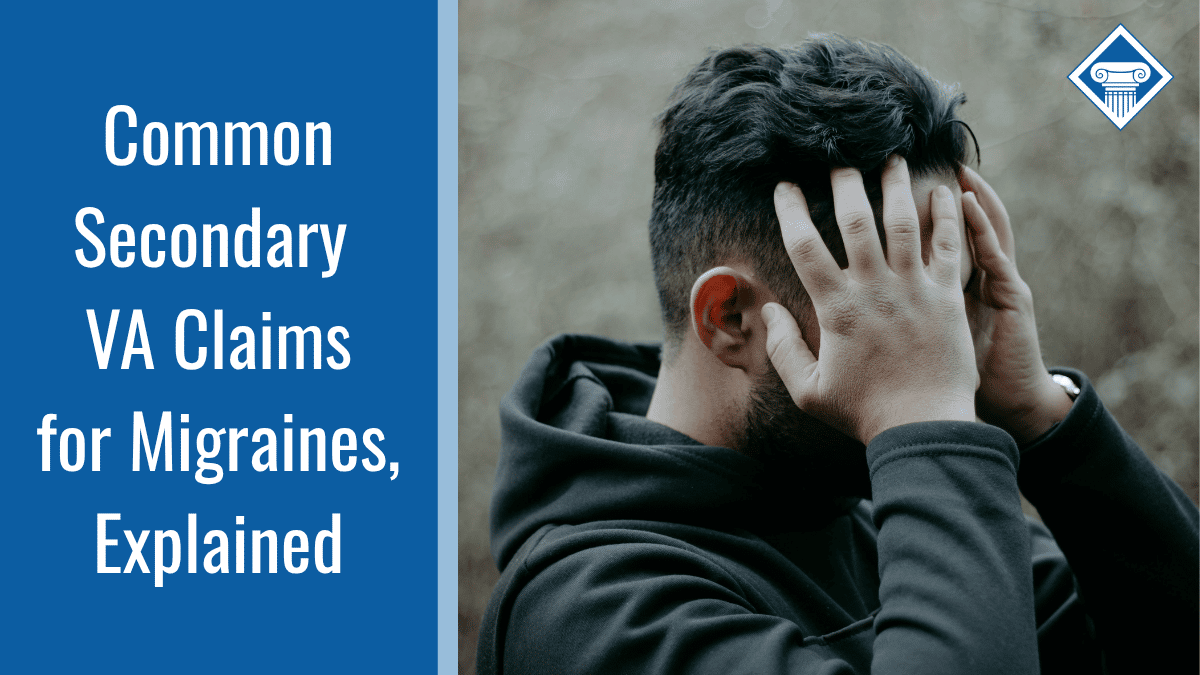
Migraines are an often debilitating health issue that affect tens of thousands of veterans around the country. The pain of a migraine on its own can be hard to manage, but migraines can also lead to additional health concerns.

Our team is ready to help
Secondary VA claims for migraines allow veterans to receive benefits for conditions caused or worsened by their service-connected migraines. In some cases, this may include a VA rating for vertigo, neck pain, depression, sleep apnea, and more.
Below, we walk through several conditions that may be linked to migraines and how the VA addresses them.
In this article about secondary VA claims for migraines:
- VA disability for migraines
- What is a secondary service connection?
- Secondary VA claims for migraines
- VA rating for vertigo secondary to migraines
- Insomnia secondary to migraines VA disability
- Anxiety and depression secondary to migraines VA disability
- Neck pain secondary to migraines VA disability
- Sleep apnea secondary to migraines VA disability
- How Woods & Woods can help
- Frequently asked questions
VA disability for migraines
Migraines are severe, debilitating headaches. Unlike a typical headache, people with migraines often experience additional symptoms like auras, sensitivity to light and sound, nausea, or fatigue.
Veterans are diagnosed with migraines more often than the general population, and deployment increases this risk even more. One study found 36% of individuals who deployed to Iraq for at least a year reported migraine symptoms.
Nearly a million veterans receive VA disability compensation for migraines, making it the ninth most commonly service-connected condition, according to the VA’s most recent data.

What is a secondary service connection?
When a service-connected disability causes or aggravates another disability, this is called a secondary service connection. A veteran can receive a secondary service-connected disability rating for a health condition that is medically related to another service-connected condition.
To qualify, there must be medical evidence showing a clear link, called a nexus, between the primary condition and the secondary condition. In other words, the secondary condition would not have developed, or would not be as severe, without the existence of the primary service-connected disability.
Secondary VA claims for migraines
Below we share several conditions that veterans commonly link to service-connected migraines on a secondary basis.
Our list is not exhaustive. If you have other health issues you believe are connected to your migraines, you may still be able to pursue a secondary claim. You can speak with your healthcare provider about whether they believe your health conditions are related.
Excellent, friendly and professional. Got me 100% P&T. Very grateful for how they have helped my family and I.

B.M., an Army veteran in Kentucky
From a Google review for Woods & Woods
VA rating for vertigo secondary to migraines
Vertigo is a condition that causes dizziness and disorientation. One type of migraine, called vestibular migraines, commonly involves vertigo and other balance-related symptoms. Vestibular migraines may or may not cause pain.
For veterans with vertigo due to an inner ear issue like vestibular migraines, the VA typically uses diagnostic code 6204 for peripheral vestibular disorders. Veterans rated under this code can receive a 30% rating for “dizziness and occasional staggering” or 10% for “occasional dizziness.”
Insomnia secondary to migraines VA disability
Insomnia is a sleep disorder that makes it difficult to fall asleep or stay asleep. Research has found insomnia may be more common in people with migraines. Poor sleep can also trigger a migraine, creating a vicious cycle.
Insomnia is commonly rated under the General Rating Formula for Mental Disorders. Ratings range from 0% to 100%, depending on how severe the symptoms are and how much they affect your ability to function at work and in daily life.
If your insomnia is caused or worsened by your service-connected migraines, you may qualify for additional compensation through a secondary VA claim.
Anxiety and depression secondary to migraines VA disability
Anxiety and depression are mental health conditions that affect your emotions, thoughts, and ability to function.
Research suggests there may be a strong connection between migraines and mental health conditions. One study found almost 80% of people who experience migraines were also affected by depression at some point in their lives. Another found 50% of migraine sufferers meet the criteria for an anxiety disorder.
Additionally, chronic, life-altering health conditions like severe migraines can cause a person to develop a mental health disorder like anxiety or depression.
As with insomnia, the VA rates both anxiety and depression under the General Rating Formula for Mental Disorders. Ratings can range from 0% to 100%.
Neck pain secondary to migraines VA disability
Neck pain is commonly reported alongside migraines. One study found between 73% and 90% of people with migraines or tension headaches also experience neck pain.
The VA typically rates neck pain based on how much it limits your movement and range of motion. If your neck pain is not tied to a diagnosed condition but is still service-connected, you should be eligible for VA benefits under the rules on painful motion and functional loss.
If your neck pain is caused or worsened by your service-connected migraines, you may qualify for additional compensation.


Sleep apnea secondary to migraines VA disability
Veterans with service-connected migraines may be owed additional compensation if you can show they cause or worsen your sleep apnea.
Obstructive sleep apnea (OSA) is a sleep disorder where breathing repeatedly stops and starts during sleep, leading to poor rest and ongoing fatigue. While some studies have found OSA may trigger migraines, other research has suggested there is no “statistically significant” connection between the two conditions. A doctor can help determine if your sleep apnea is secondary to migraines for VA disability.
The VA rates sleep apnea under diagnostic code 6847, with ratings ranging from 0% to 100%.
How Woods & Woods can help
Our team of VA-accredited attorneys, legal analysts, case managers, and intake specialists help veterans nationwide get the benefits they deserve. If you’re tired of appealing one VA decision after another, call us today for a free case evaluation.
Ready to get started?

Frequently asked questions
Yes. Migraines can be linked to several secondary conditions, including but not limited to vertigo, sleep apnea, insomnia, anxiety, depression, neck pain, and GERD.
If you have vestibular migraines and your only symptom is vertigo with no pain, you will most likely receive just one VA rating under DC 6204 for peripheral vestibular disorders. However, if you experience severe migraine pain as well as vertigo, you may be able to receive VA disability for both health issues. However, you will need to establish that your service-connected migraines cause or worsen the vertigo.

Neil Woods
Neil Woods is a VA disability attorney and the owner and president of Woods & Woods. He received his law degree from Western Michigan University.