
Veterans seeking PTSD VA benefits may want to better understand the rating criteria the VA uses and how much they can receive in monthly payments.
Let’s appeal your VA decision today

That’s why we’ve created a PTSD VA rating chart to help you quickly understand VA disability for this condition. We also explain what veterans can do to increase their PTSD rating, whether the VA can take away a PTSD rating, and TDIU benefits for veterans whose PTSD prevents them from working.
Key Takeaways
- This article includes a 2026 PTSD VA rating chart that you can download and keep as a reference as you navigate your PTSD VA disability claim.
- PTSD is rated using the General Rating Formula for Mental Disorders and can be assigned a rating of 100%, 70%, 50%, 30%, 10%, or 0%.
- Veterans with severe PTSD may also be eligible for total disability based on individual unemployability, or TDIU.
In this article about the VA PTSD rating chart:
PTSD VA rating chart
Veterans can receive a PTSD VA rating if the condition was caused or worsened by military service.
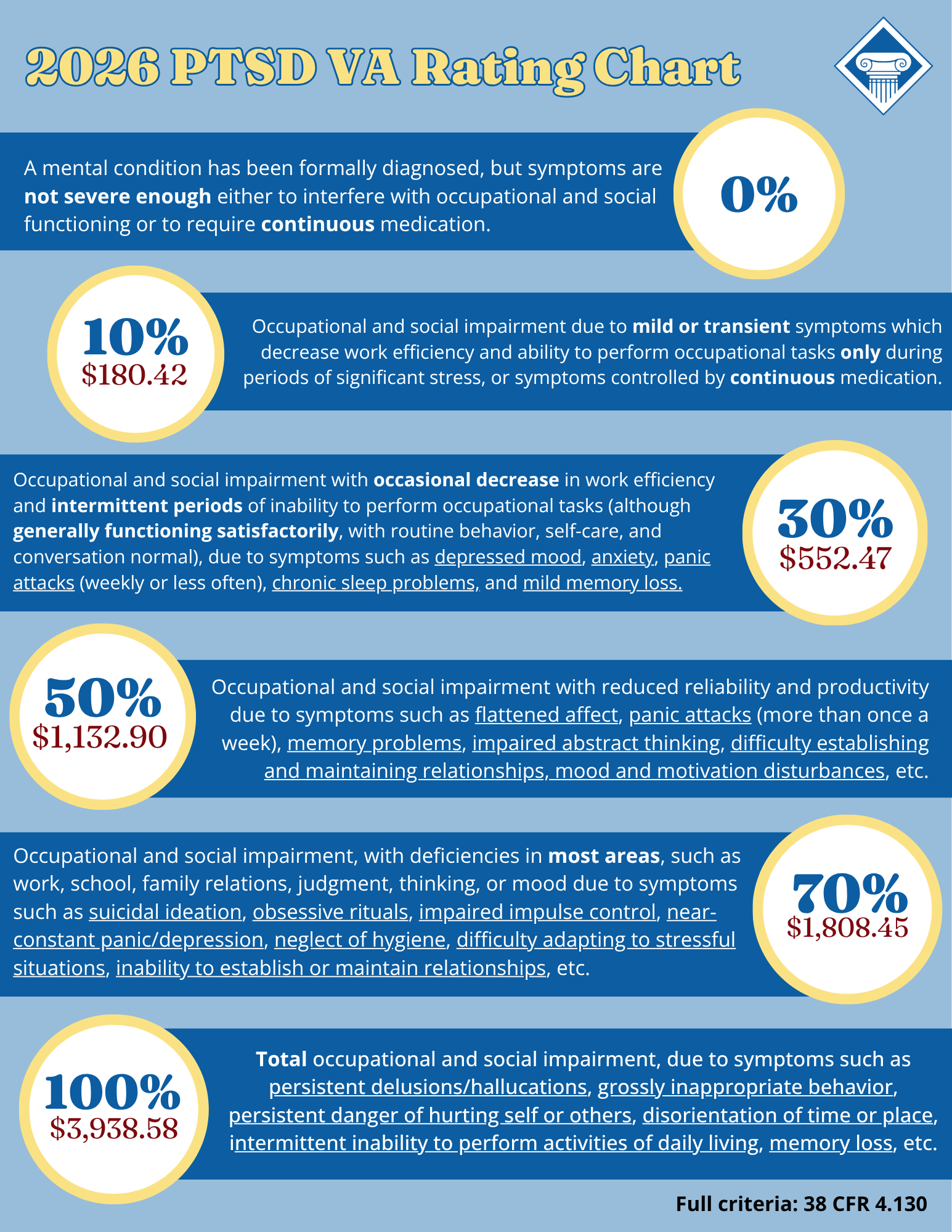
The VA rates PTSD using the General Rating Formula for Mental Disorders as follows:
Monthly payment amounts can increase for veterans with spouses or dependent children or parents, or for those eligible for special monthly compensation (SMC) benefits.
You can download the VA PTSD rating chart below.
PTSD and veterans
PTSD is a severe trauma disorder. It can be brought on after a person is exposed to an extreme, sometimes life-threatening, stressor and can’t process the related emotions.
About 7% of veterans experience PTSD, and this number increases significantly in veterans who served in Iraq or Afghanistan. In fact, PTSD is the sixth most commonly service-connected condition for VA disability benefits. More than 1.5 million veterans currently receive VA compensation for PTSD.
PTSD can develop almost immediately or years after a traumatic event. Symptoms include nightmares, flashbacks, intrusive thoughts, depression, anxiety, and more.
You do not have to be recently discharged to qualify for a PTSD VA rating, nor do you have to have seen combat. However, you will need to be prepared to prove your PTSD is service connected to receive disability compensation.

Increasing a PTSD VA rating
Many veterans receive a PTSD VA rating they feel is too low and does not properly reflect the severity of their condition. Thankfully, veterans have the right to appeal if they are denied benefits or want to increase their disability rating.
We share more about increasing your PTSD rating in our article on the topic.
Depending on the specifics of your VA claim, when you’re ready to appeal your PTSD decision, there are a few different paths you can take. Having a VA disability attorney or other accredited VA representative who understands the best route for your appeal can help prevent delays and ensure you receive the compensation you deserve.
Can the VA reduce your disability rating for PTSD?
For the most part, the VA can reduce your PTSD disability rating, or any other rating, if it believes a reduction is warranted based on your medical documentation, C&P exam results, and other evidence.
However, if you do not appeal your PTSD decision, the VA is not likely to look at your case again for two to five years. That’s how often it schedules what are known as “periodic future examinations.” These medical exams evaluate the current state of your service-connected condition to see if it has improved. If you were awarded a prestabilized 50% VA disability rating for PTSD, your reexamination will be scheduled within six months following your separation from service.
After a reexamination, it’s possible for your VA rating to be taken away altogether, reduced, or increased based on the results. Your benefits may also remain the same if the VA determines your condition is unchanged.
Woods & Woods handled my case with extreme excellence and professionalism. I never imagined being so lucky as to the comfort of knowing this firm was working for me. I have highly recommended them already with other clients. Thank you so much Woods & Woods.

M.D., a veteran in Missouri
From a Google review for Woods & Woods
VA unemployability for PTSD
Symptoms like depression, fatigue, anxiety, and many others can make it impossible for a person to find and keep employment.
Some veterans with PTSD can’t maintain what the VA calls “substantially gainful employment” because of their symptoms. These veterans are entitled to total disability based on individual unemployability (TDIU). This tax-free monthly benefit ensures those veterans can still support themselves and their families despite their inability to work.
Veterans eligible for TDIU receive VA disability compensation at the 100% rate without their condition being rated 100% disabling.
How Woods & Woods can help
Our TDIU lawyers have helped thousands of veterans nationwide who can no longer work because of their service-connected conditions. Call us today for your free, confidential TDIU case evaluation. You won’t pay us unless we win your claim.
Don’t fight the VA alone

Frequently asked questions
The VA uses the rating criteria found in the General Rating Formula for Mental Disorders to evaluate PTSD caused by military service. We have turned this information into a downloadable VA PTSD rating chart that can be found here.

Neil Woods
Neil Woods is a VA disability attorney and the owner and president of Woods & Woods. He received his law degree from Western Michigan University.


