
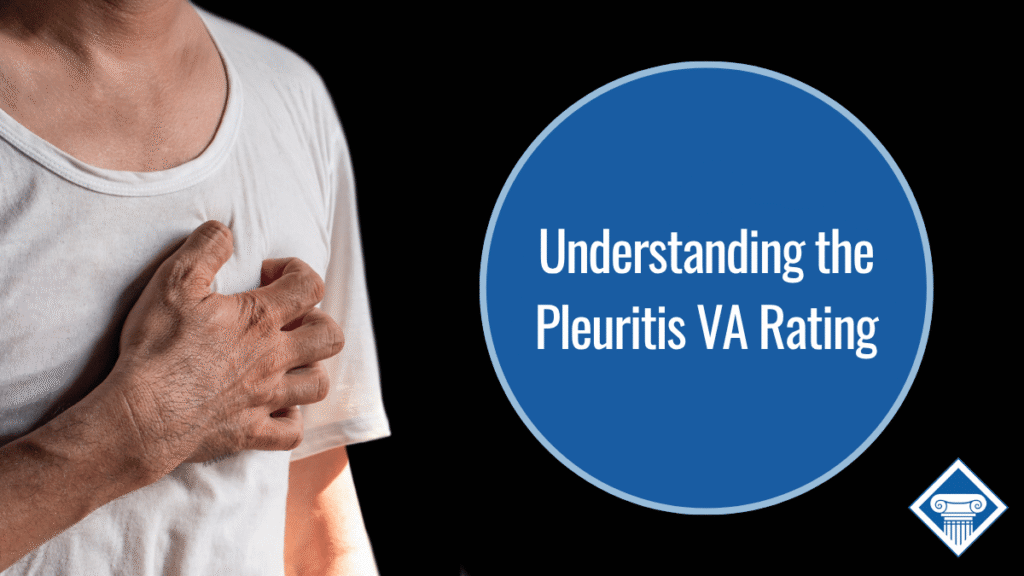
Pleuritis, also known as pleurisy, is a painful condition that causes inflammation in the lining around the lungs and chest wall. For veterans, this condition may develop after exposure to burn pits, respiratory infections, or chest injuries experienced during service.
Don’t fight the VA alone

The sharp chest pain and breathing difficulties associated with pleuritis can interfere with daily life, making it difficult to work, exercise, sleep, or perform routine tasks.
In this article we discuss what pleurisy is, how veterans can connect the condition to military service, and how a pleuritis VA rating is evaluated.
Key Takeaways
- Veterans may develop pleuritis due to respiratory infections, chest injuries, or exposure to burn pits or other airborne hazards during military service.
- Depending on the type of pleuritis you’re diagnosed with, the VA may use the General Rating Formula for restrictive lung disease or the General Rating Formula for interstitial lung disease.
- Veterans can get a pleurisy VA rating between 10% and 100%.
In this article about the pleuritis VA rating:
What is pleuritis?
Pleuritis is a condition where the lining around the lungs and chest wall becomes inflamed. Normally, these layers slide smoothly against each other when you breathe, but with pleurisy they rub together, causing sharp chest pain.
Common symptoms of pleuritis may include:
- Chest pain that worsens with breathing, coughing, or sneezing
- Shortness of breath
- Cough
- Fever
Veterans may develop pleuritis due to respiratory infections, chest injuries, or exposure to burn pits or other airborne hazards during military service.
Because the condition can be linked to service-related exposures and underlying lung diseases, some veterans may qualify for VA disability benefits through direct, secondary, or presumptive service connection.
Pleuritis VA rating
If you’re a veteran with pleuritis that was caused by an exposure or experience during military service, you may be eligible for a pleuritis VA rating.
Pleuritis is often rated analogously, meaning the VA uses a diagnostic code for another condition with similar symptoms.
Depending on the specific type of pleuritis you’re diagnosed with, the VA may use the General Rating Formula for restrictive lung disease or the General Rating Formula for interstitial lung disease, both found in the Schedule of Ratings for the respiratory system.
The diagnostic codes for interstitial lung disease provide ratings of 10%, 30%, 60%, or 100% depending on your forced vital capacity (FVC). Forced vital capacity is a measurement of the total amount of air you can forcibly exhale after inhaling as deeply as possible.
Those rating criteria are as follows:
Diagnostic codes for restrictive lung disease also provide possible ratings of 10%, 30%, 60%, or 100%, which are determined by your forced expiratory volume (FEV). The VA looks specifically at a veteran’s FEV-1, which measures the maximum amount of air you are able to exhale in one second.
The rating criteria for pleuritis rated analogously as restrictive lung disease are outlined below:
If your condition developed as a result of active or inactive tuberculosis, the VA will rate it using diagnostic code 6732. This diagnostic code instructs the VA to apply the guidelines outlined in either § 4.88c.
§ 4.88c is used to evaluate pleuritis caused by inactive nonpulmonary tuberculosis that was service connected after August 19, 1968. This rule instructs the VA to rate the condition at 100% for one year after inactivity. After one year, a veteran’s pleuritis will be rated based on any residuals.
My husband was treated with such respect and was helped beyond what we could have ever hoped for. The staff is very reliable and returns calls in a timely fashion. Thank you for all the help with my husband’s case.

E.M., a veteran’s wife in South Carolina
From a Google review for Woods & Woods
Pleuritis and burn pits
Pleuritis can develop after exposure to burn pits because the toxins and airborne particles in the smoke can irritate and inflame the lungs. Breathing in these substances over time may damage the respiratory system and lead to inflammation of the pleura.
Under the PACT Act, certain respiratory conditions, including pleuritis, are formally connected to burn pit exposure and considered presumptive by the VA.
With presumptive conditions, you do not have to submit proof of service connection. You only need to prove that you served in a qualifying location and time period associated with burn pit exposure.
TDIU for pleuritis
Pleuritis can leave you short of breath and cause severe chest pain that can make completing routine tasks difficult and uncomfortable. Veterans with chronic pleuritis may find their symptoms keep them from maintaining employment.
Luckily, veterans who can’t work due to their service-connected conditions may qualify for total disability based on unemployability (TDIU) benefits.
Veterans who receive TDIU benefits are compensated at the same level as those with a 100% disability rating, even though their combined rating is below 100%.
Veterans will typically be eligible for TDIU if they have:
- At least one service-connected disability rated at 60% or more disabling OR
- Two or more service-connected disabilities with at least one rated at 40% or more disabling and a combined rating of 70% or more
How Woods & Woods can help
Our team of VA-accredited attorneys, legal analysts, case managers, and intake specialists help veterans nationwide get the benefits they deserve. If you’re tired of appealing one VA decision after another, call us today for a free case evaluation.

Let’s get started today
Frequently asked questions
Yes. Veterans may qualify for a pleuritis VA rating if their condition is connected to their military service. A pleurisy VA rating may be granted through a direct service connection, a secondary service connection, or a presumptive connection related to burn pit or toxic exposure under the PACT Act.
Veterans may face a higher risk of pleurisy because of conditions and exposures experienced during military service. Common risk factors include respiratory infections like pneumonia or tuberculosis, chest trauma or rib injuries, and exposure to burn pits. These exposures can irritate the lungs and pleural lining.

Neil Woods
Neil Woods is a VA disability attorney and the owner and president of Woods & Woods. He received his law degree from Western Michigan University.