• Skip to main content
Let's Talk About Your Claim
(812) 426-7200
Get a Free Case Evaluation
Woods & Woods, LLC, Veterans Disability Lawyers

Woods & Woods, LLC, Veterans Disability Lawyers

VA Disability Attorney Helping Veterans Near You

  • VA Appeals
    • TDIU
    • Survivors (DIC)
    • Our VA Wins
    • VA Disability 101
  • Our Practice Areas
    • Product Liability
    • SSDI
  • Resources
    • VA Blog
    • SSDI Blog
    • VA Rating Calculator
    • VA Back Pay Calculator
    • Toxic Exposures
    • VA Disability 101
    • Benefits by State
  • About
    • Contact
    • Careers
    • Press
    • Woods & Woods Foundation
Home » VA Blog » VA Disability for Eating Disorders

In this article

  • Veterans and eating disorders
  • Eating disorder VA rating
  • Eating disorders and related conditions
  • TDIU for eating disorders
  • How Woods & Woods can help
  • Frequently asked questions

VA Disability for Eating Disorders

November 14, 2024 by Neil Woods

Eating disorders are mental health disorders that can cause significant physical health problems. If you developed an eating disorder as a result of your military service or an existing disorder was worsened by service, you may be entitled to VA disability compensation. You’ll want to understand the eating disorder VA rating.

Don’t fight the VA alone

(812) 426-7200

Get Your Free Case Evaluation
An older soldier standing with his back to the camera watching an American flag wave.

You saw and experienced extremely difficult things while you were on active duty. Then, you were diagnosed with a trauma disorder after you returned home. You thought you were improving with treatment, but now you can’t bring yourself to eat. You’re rapidly losing weight, and your doctor says you’ve developed an eating disorder. This post explains how that too may be related to your service.

In this article about the eating disorder VA rating:

  • Veterans and eating disorders
  • Eating disorder VA rating
  • Eating disorders and related conditions
  • TDIU for eating disorders
  • How Woods & Woods can help
  • Frequently asked questions

Veterans and eating disorders

An eating disorder is a mental health issue that affects a person’s emotional and physical health. It is typically the result of a skewed self or body image. 

The three most common types of eating disorders are:

  1. Anorexia nervosa. A person restricts their caloric intake, sometimes almost to the point of starvation.
  2. Bulimia nervosa. A person eats large amounts of food, then rids their body of it through methods like vomiting, laxative use, or extreme amounts of exercise.
  3. Binge eating disorder. A person eats large amounts of food in one sitting and is unable to stop.
A woman sits with her legs pulled up to her chest and her head in her hand. Over the image is a red box reading the article title: Is there an eating disorder VA rating?

About 9% of the U.S. population will develop an eating disorder at some point in their life. Active duty service members and veterans are more likely to develop eating disorders than the general population. One study found eating disorders in veterans were about 9% in males and 19% in females. 

One reason veterans are more prone to eating disorders is their exposure to trauma and the subsequent development of mental health disorders, like post-traumatic stress disorder (PTSD), as a result. There is a clear relationship between emotional trauma and the development of disordered eating.

Eating disorder VA rating

The VA rates eating disorders based on the severity of the condition. It rates anorexia under diagnostic code 9520 and bulimia nervosa under diagnostic code 9521 in the Schedule of Ratings, but both rating criteria are the same. The rating criteria is as follows:

DescriptionVA RatingMonthly payment (vet only)
Self-induced weight loss to less than 80 percent of expected minimum weight, with incapacitating episodes of at least six weeks total duration per year, and requiring hospitalization more than twice a year for parenteral nutrition or tube feeding.100%$3,938.58
Self-induced weight loss to less than 85 percent of expected minimum weight with incapacitating episodes of six or more weeks total duration per year.60%$1,434.02
Self-induced weight loss to less than 85 percent of expected minimum weight with incapacitating episodes of more than two but less than six weeks total duration per year.30%$552.47
Binge eating followed by self-induced vomiting or other measures to prevent weight gain, or resistance to weight gain even when below expected minimum weight, with diagnosis of an eating disorder and incapacitating episodes of up to two weeks total duration per year.10%$180.42
Binge eating followed by self-induced vomiting or other measures to prevent weight gain, or resistance to weight gain even when below expected minimum weight, with diagnosis of an eating disorder but without incapacitating episodes.0%None
source: schedule of disability ratings

The VA defines an “incapacitating episode” as a period when bed rest and medical treatment are necessary.

It’s important to note that the above rating criteria doesn’t apply to binge eating disorder. If binge eating is a problem, the VA should consider the condition’s potential relationship to co-occuring mental health disorders such as PTSD or major depressive disorder.


A blue banner reading: Veterans: You could be owed $3900+ a month. Learn more about VA TDIU benefits. To the left of the text is an older male veteran in glasses and a hat, smiling. To the right is a younger female veteran, turning in a chair to smile at the camera.
A blue banner reading: You could be owed $3900+ a month. Learn more about VA TDIU. Also features images of VA-accredited Cecilia Ton, Lori Underwood, and Zack Evans.

Eating disorders and related conditions

The majority of people (55-97%) with eating disorders have a co-occurring condition, or another mental health disorder that exists along with the eating disorder. Some common co-occurring disorders linked with eating disorders also may qualify for VA disability benefits. That means the eating disorder may be secondarily connected to these disorders or vice versa. 

Common mental health conditions linked to eating disorders include:

  • PTSD
  • Anxiety
  • Depression
  • Alcohol or substance abuse disorders
  • Obsessive-compulsive disorder (OCD)

Some of these issues may fall under the VA’s disability rating for mental health disorders. 

Researchers also have found a relationship between sexual assault and the development of eating disorders. That means survivors of military sexual trauma may be more prone to developing an eating disorder. If that’s the case, both conditions should be service connected.

Eating disorders also can cause physical health conditions like diabetes, high blood pressure, and heart disease. You may also be able to service connect those conditions, if they develop as a result of a service-connected eating disorder.

Woods & Woods are the only attorneys I would recommend for veterans, they did a great job for me. 100 percent P&T disability, very caring and understanding. They will not quit until they win. I am so thankful for what they did for me.

Diamond shaped logo of the top of a column, serving as a portion of the Woods & Woods VA Disability lawyers logo.

B.C., a Navy veteran in California

From a Google review for Woods & Woods


TDIU for eating disorders

A veteran can be awarded total disability based on individual unemployability (TDIU) benefits if they can’t maintain substantially gainful employment due to service-connected conditions. 

Eating disorders can often lead to feelings of shame, embarrassment, and anxiety that may make it harder to go out in public. Additionally, veterans with anorexia, bulimia, or binge eating disorder may struggle with other serious mental health disorders such as PTSD, which can make it difficult to cooperate on a team or in a work environment.

TDIU pays at the same level as a 100% disability rating, even when the veteran’s combined rating is below 100%. 

Veterans will typically be eligible for TDIU if they have:

  • One service-connected disability rated at 60% or more disabling OR 
  • Two or more service-connected disabilities with at least one rated at 40% or more disabling and a combined rating of 70% or more.
How Veterans Feel About Woods and Woods
Veterans share their experiences working with the VA disability lawyers at Woods & Woods

How Woods & Woods can help

Our TDIU lawyers have helped thousands of veterans nationwide who can no longer work because of their service-connected conditions. Call us today for your free, confidential TDIU case evaluation. You won’t pay us unless we win your claim.

Woman soldier smiling and gesturing to her audience.

Our team is ready to help

(812) 426-7200

Get Your Free Case Evaluation

Frequently asked questions

Does military trauma cause eating disorders?

While experiencing military trauma doesn’t automatically mean a person will develop an eating disorder, trauma and stress can be significant contributors to the development of eating disorders. 

Are women in the military more likely to develop an eating disorder?

Yes, women are more likely, in general, to develop an eating disorder than men. This fact remains true in military diagnoses.

Neil Woods is a VA disability attorney and the owner and president of Woods & Woods. He received his law degree from Western Michigan University.

Neil Woods

Neil Woods is a VA disability attorney and the owner and president of Woods & Woods. He received his law degree from Western Michigan University. 

VA Accreditation Number: 44739

Filed under: Mental Health Conditions

Related

R.D. gave Woods & Woods, LLC 5 out of 5 stars.

They are Incredible

One of 1901 reviews from Facebook and Google.

Logo for NOVA, with a link to the National Organization of Veterans' Advocates website
American World War II Heritage City logo
Woods & Woods is the Tour of Honor sponsor for Honor Flight Southern Indiana EVV21.
Seal of the USCAVC with the word "Member" at the bottom
  • Contact Us
  • VA Blog
  • Sitemap
  • Payment Options
  • Press
  • Benefits by State
  • VA Disability 101

Sign up to stay updated on VA news, policy changes, and more.

"*" indicates required fields

Copyright © 2026 Woods & Woods, LLC | PO Box 1287 Evansville, IN 47706

THIS IS AN ADVERTISEMENT

Disclaimer, Privacy Policy, and Accessibility Statement

Entering ratings

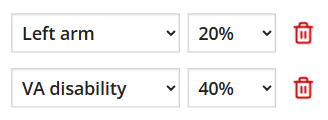
Injuries to the arms and legs are entered separately from other ratings to account for the VA's bilateral factor. Here is an example of how our calculator works for a veteran with a 20% rating for a left hand injury and a 40% PTSD rating:

Screenshot of two ratings entered in the calculator. The first is Left arm at 20%. The second is a general VA disability at 40%.

Your result will appear below your selections. It includes the VA-calculated final rating as well as the rating before rounding, and your expected monthly payments.

Screenshot of the results from the two entered ratings. The results show the combined rating of 50%, the actual rating of 52%, and a monthly payment of $1132.90.

GET HELP WITH YOUR VA BENEFITS

"*" indicates required fields

Already working with us? Please complete this form to send us your message instead.

Name*
Woods & Woods Email Newsletter
Permission to Contact*
This communication with the firm or any member of the firm does not establish an attorney-client relationship. Confidential or time-sensitive information should not be sent through this form.

By submitting this form, you agree to the terms of our Privacy Policy.

This field is hidden when viewing the form