A 70% rating for PTSD is the second-highest rating the law allows for PTSD. The rating indicates that it is difficult for a veteran to lead a normal life in all areas including work, school, and family. They are also likely to experience problems with their judgment and their emotions.
Although a 100% rating for PTSD is possible, a 100% disability rating for any condition is difficult to get. The VA’s standard for a 100% PTSD rating is total occupational and social impairment.
Here, we will discuss how we can help you increase your PTSD rating to 70%.
Talk to Us About Your Claim:
(812) 426-7200
In this article about 70% PTSD VA ratings:
What is PTSD? Is PTSD a Disability?
The VA defines post-traumatic stress disorder (PTSD) as a mental health condition that some people develop after experiencing or witnessing a life-threatening event, such as combat, a natural disaster, a car accident, or sexual assault.
Everyone experiences PTSD differently, but these are the common symptoms that warrant a 70% rating:
- Near-continuous panic or depression that affects the ability to function independently and effectively
- Difficulty adapting to stressful situations, including work or a work-like setting
- Having speech that is sometimes illogical, inappropriate, or irrelevant
- Having suicidal thoughts and ideations
- Inability to form and maintain effective relationships with others
- Having obsessive rituals or routines that interfere with daily activities
- Impaired impulse control, such as unprovoked irritability with periods of violence
- Spatial disorientation
- Neglect of personal hygiene and appearance
As a widow of a disabled veteran and getting nowhere with the VA on my DIC claim, I contacted Woods & Woods for help. They were able to win my claim. They were very caring and kept me up to date every step of the way. I cannot thank them enough for all they have done for me.

A.M., a veteran’s widow in Pennsylvania
From a Google review for Woods & Woods
Causes of PTSD
Anyone who experiences or witnesses an event that involves actual or threatened death, violence, sexual assault, abuse, or a natural disaster can develop PTSD.
The condition affects about 3.5% of the U.S. adult population, and an estimated one in 11 people will be diagnosed with PTSD during their lifetime. The National Institute of Mental Health found that people with a history of anxiety and depression are more likely to develop PTSD after a traumatic event.
According to the Mayo Clinic, PTSD may be a result of:
- Previous experience with traumatic events
- Family history of mental health disorders, such as anxiety and depression
- Your personality
- The way your brain regulates chemicals and hormones in response to stress
A veteran with a history of anxiety or depression or who has experienced traumatic events before military service is at an increased chance of developing PTSD following traumatic events during military service.
Applying for mental health VA disability
Many veterans often feel ashamed of their mental health disorders and sometimes under-report their symptoms because they don’t want to appear weak or damaged.
It is important to remember that it is OK to ask for help when you need it. The VA recognizes that service in the military can take a toll on mental health, which is why benefits are available for mental health disorders.

To apply for VA disability compensation for PTSD, you need to first file a claim through the VA. If you need help applying for VA disability compensation for the first time, we can help guide you through the process at no charge.
After the VA reviews your claim, you will receive a rating decision letter that outlines your disability rating and your monthly payments. If you disagree with the VA’s decision, you can appeal it within one year of the decision date. If you need help appealing a decision, a veterans benefits attorney can help.

Differences between PTSD VA ratings
The difference between a 50% and a 70% PTSD rating is how severely the condition is affecting a person’s job and life. You should be completely honest during your Compensation and Pension (C&P) exam, which could be the tipping point between two ratings.
At 70%, a veteran has occupational and social impairment with difficulties in most areas, including work, school, family relations, judgment, thinking, and mood. People rated at 70% are living in a near-constant state of panic or depression. The 70% level is where suicidal ideation is first mentioned in the rating schedule.
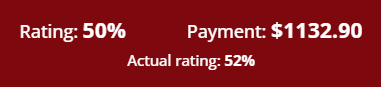
Another difference between PTSD ratings is the amount of monthly compensation. The monthly payment for a 50% disabled veteran is $1,132.90 each month compared to $1,808.45 for a 70% rating. The amount goes up with the number of dependents.
Despite what you may have heard, there is not an automatic 50% rating rule for PTSD. It is possible to get a 30% rating or even a 0% rating. The VA gives a 30% rating when there is an occasional decrease in work efficiency and intermittent periods of inability to perform occupational tasks. Veterans rated at 30% generally function well, with normal behaviors. A 0% rating is given when a veteran has a formal diagnosis of PTSD, but symptoms are not severe enough either to interfere with occupational and social tasks or to require continuous medication.
From the day we contacted [Woods & Woods], they made us feel so comfortable. They treated us like we mattered and we were not just clients but family.
L.B., a Navy veteran and wife in Florida
From a Google review for Woods & Woods
How do you get a 70% PTSD VA rating?
For any VA disability claim, you need to provide, to the VA, a diagnosis along with proof that the disorder is related to your time in the service. The diagnosis may be documented during a C&P exam with a VA-appointed mental health expert or your own mental health expert.
You should start by honestly relaying all your symptoms at your C&P exam. It’s important to express the severity of your symptoms and not hold back on any details, even if they are embarrassing or bizarre. Some symptoms that may seem irrelevant might help your case. Please call if you would like to review the criteria of the symptoms with us.
During this evaluation, you will need to recall stressors, which are specific incidents or events from your time in service that caused to your PTSD. If you do not present evidence of a stressor, the VA will not service connect your PTSD and will most likely consider it as another mental health disorder. A veteran without an in-service stressor does not prevent future service-connection for a similar mental health condition.
You will also need to provide a medical nexus letter, which is a certified statement from your doctor that describes the connection between your condition and your military service. Your doctor must confirm that your condition was “at least as likely as not” caused by your military service.
“Buddy statements” are also a great way to support your PTSD claim. These are statements from friends, family members, or fellow service members that reveal how your disability impacts your daily life. Buddy statements may also help with confirming the occurrence of an in-service stressor.
How Woods & Woods can help
Hiring experienced VA lawyers can help you improve your case. Woods & Woods can work to help you increase your PTSD disability rating. We will help you file paperwork, obtain all the necessary documents (including buddy statements), and help you through the appeals process.
Our goal is to help veterans get the benefits they deserve. We understand the sacrifice that veterans have made, and it is our goal to ensure that your time in service is not forgotten.
We offer free, no-obligation consultations and we only charge a fee if we win your appeal. Contact us today to learn more about how we can help with your PTSD disability claim.
Let’s get started today
Frequently asked questions
Yes, and many veterans receive VA benefits every month for their PTSD. You need to have a professional diagnosis and prove your condition is service-connected. The average rating is 70%, which means those veterans get $1,808.45 per month for PTSD.
No, there is no automatic 50% rating rule for PTSD. The criteria for an automatic rating are very strict, we can still help you build a strong case.
A veteran who is rated at 70% has occupational and social impairment with difficulties in most areas, including work, school, family relations, judgment, thinking, and mood. People rated at 70% are living in a near-constant state of panic or depression and might be having suicidal thoughts.

Neil Woods
Neil Woods is a VA disability attorney and the owner and president of Woods & Woods. He received his law degree from Western Michigan University.